Smoke and Mirrors: The False Promise of Staging Environment Parity
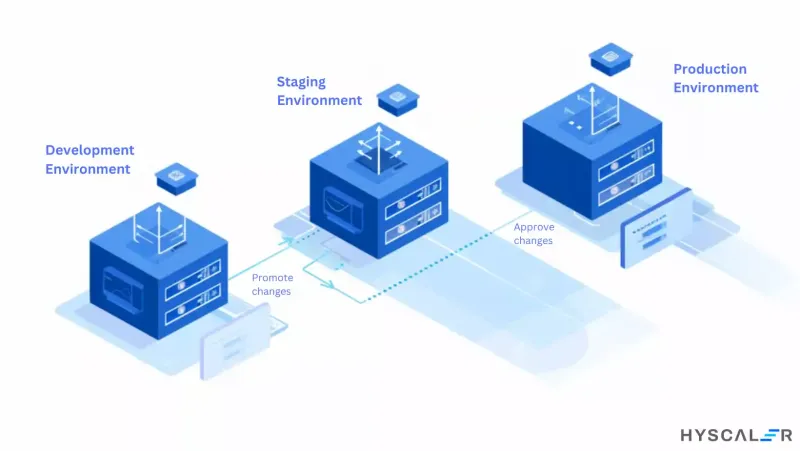
Photo: server room staging deployment testing environment technology, via assets.hyscaler.com
There is a particular kind of confidence that comes from watching a deployment succeed in staging. The tests pass, the smoke checks clear, and the team signs off with the quiet assurance that production is next and that it will behave identically. It rarely does.
At JFDP Labs, we have observed this pattern across engineering organizations of every size. The staging environment is treated as a dress rehearsal, and production is treated as opening night. What nobody talks about loudly enough is that the stage itself is different, the audience is different, and the acoustic properties of the room bear almost no resemblance to the one where it actually matters.
Why True Parity Is Structurally Impossible
The argument for staging parity sounds reasonable: replicate the production environment as closely as possible, run your tests, and ship with confidence. The problem is that "as closely as possible" is doing enormous amounts of work in that sentence, and the gap it papers over grows wider as systems become more complex.
Consider data alone. A staging environment almost never carries a full production dataset. It may carry a sanitized subset, a synthetic approximation, or a snapshot that is weeks old. Edge cases that emerge from specific data patterns — unusual character encodings, legacy record formats, or statistically rare combinations of field values — will not manifest in a reduced dataset. Production will find them on your behalf, usually at the worst possible moment.
Then there is traffic. Production traffic is not uniformly distributed, and it is not predictable from historical averages. Real users exhibit behaviors that no load testing profile fully captures: concurrent sessions from the same account, API polling patterns from mobile clients in poor network conditions, and the occasional coordinated spike driven by a marketing campaign that engineering was not told about. Staging traffic models are approximations. The production traffic is the truth.
Third-party integrations compound this further. Payment processors, identity providers, analytics platforms, and external APIs all maintain their own production and sandbox tiers. Your staging environment almost certainly communicates with sandbox versions of these services, which are maintained with varying degrees of fidelity to their production counterparts. A behavioral change in a payment processor's production API will not show up in your staging run.
The Confidence Trap
The danger is not that staging environments fail to catch bugs. They catch plenty. The danger is that they create a systematic overestimation of how much risk has been eliminated before deployment.
This overconfidence has a compounding effect. Teams that trust staging implicitly tend to invest less in production observability, reasoning that the hard work of validation has already been done. They deploy larger changesets less frequently, which concentrates risk rather than distributing it. And when production failures do occur, the post-mortem often reveals that the failure mode was theoretically detectable — just not in the environment that was actually being watched.
The staging environment does not reduce production risk as much as it relocates the team's attention away from production risk. That is a meaningful distinction.
Designing Validation That Accounts for the Gap
None of this argues for abandoning pre-production environments. It argues for treating them honestly — as one layer in a multi-layered validation strategy, not as a production proxy.
Progressive delivery mechanisms such as feature flags, canary releases, and traffic shadowing move validation closer to where the actual risk lives. A canary deployment that routes one percent of production traffic to a new service version will surface real-world failure modes that no staging run could anticipate. The key is that the blast radius of that exposure is controlled and observable.
Synthetic monitoring in production complements this approach by running scripted user journeys against live infrastructure on a continuous basis. This is not the same as load testing in staging — it is active probing of the real environment with real dependencies, providing signal that staging simply cannot generate.
Contract testing between services reduces the reliance on full-environment integration tests by validating that the interfaces between components remain stable. When a downstream service changes its response schema, a contract test fails immediately, without requiring a full staging deployment to discover the breakage.
Chaos engineering practices — deliberately injecting failures into controlled production subsets — expose resilience gaps that staging environments, with their reduced load and sanitized data, will never surface. This is a core principle at JFDP Labs: the system must be validated under conditions it will actually face, not conditions that are convenient to simulate.
Rethinking the Role of Staging
Staging environments remain valuable for a specific and limited purpose: catching obvious regressions before they reach any live traffic. They are a fast feedback mechanism for developers, not a comprehensive validation gate for production readiness.
Organizations that recalibrate their expectations accordingly tend to make better investment decisions. Rather than pouring resources into maintaining a staging environment that approaches production fidelity — an effort that is both expensive and ultimately futile — they redirect that investment toward production observability, deployment automation, and rollback capability.
The question to ask is not "did this pass staging?" The question is "do we have the instrumentation to detect and respond to a production failure quickly enough that the risk is acceptable?" That is a harder question, but it is the right one.
Engineering confidence should be earned in production, not borrowed from a simulation of it. The teams that internalize this distinction ship faster, fail smaller, and recover more reliably than those who continue to treat the staging environment as the final word on system behavior.
The dress rehearsal is useful. Just do not mistake it for the performance.